Interoperability
LAMISPlus is built to connect. It does not operate as a standalone electronic health record. It exchanges data with national registries, shared health records, reporting systems, and laboratory platforms using internationally recognised health data standards: HL7 FHIR and CDA.
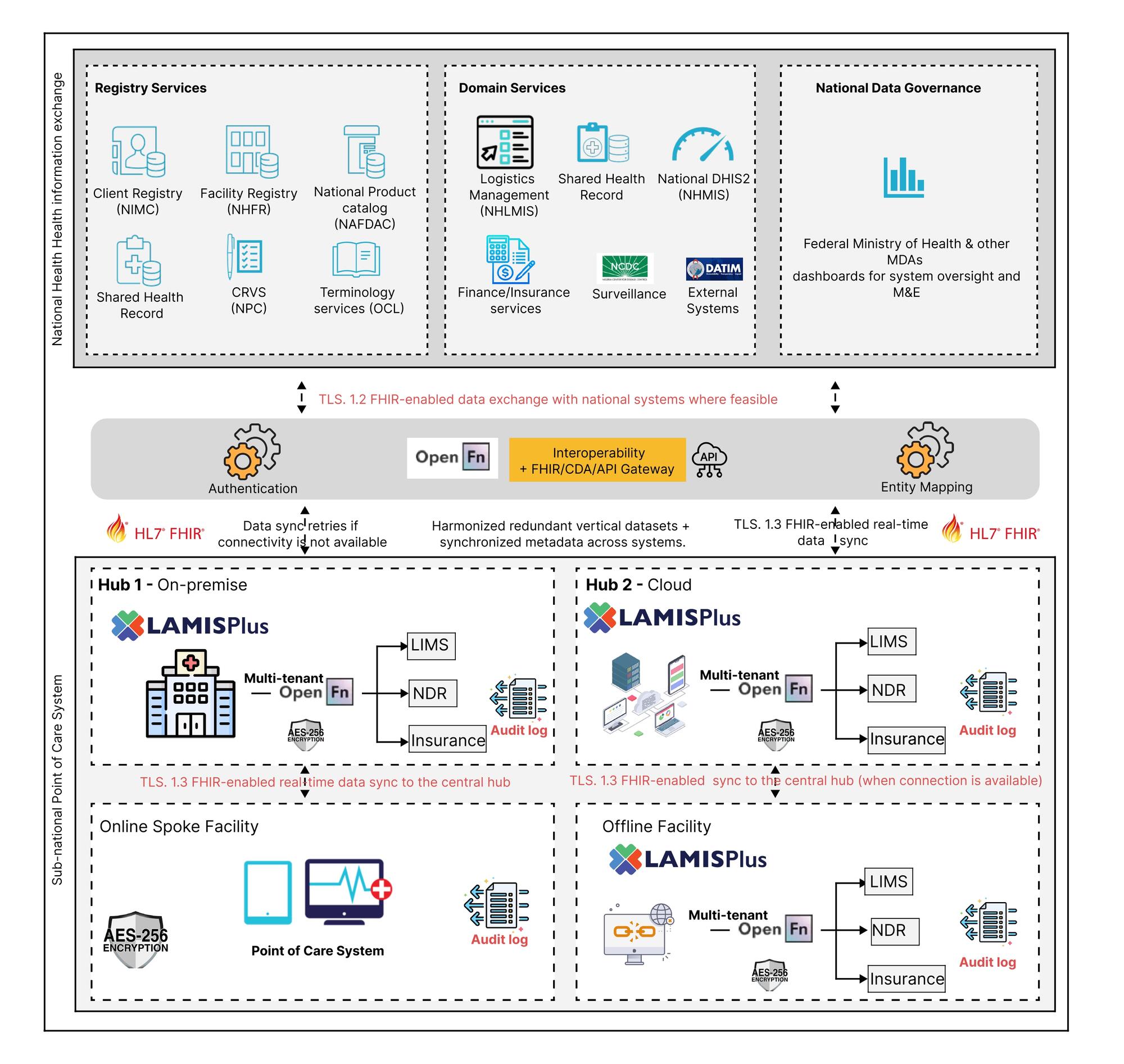
The interoperability layer
At the centre of all data exchange sits an OpenFN-powered interoperability gateway. The gateway authenticates the identity and authorisation of all systems before any exchange occurs. It translates between LAMISPlus's internal data format and the standard formats required by external systems (FHIR, CDA, and API formats). It maps patient identifiers, facility codes, and product codes across registries. If connectivity is interrupted, it queues pending syncs and retries automatically when the connection returns.
All data exchange with national systems uses TLS 1.2 or TLS 1.3 encryption in transit.
National Health Information Exchange
LAMISPlus connects to three categories of national services:
Registry Services NIMC (National Identity Management Commission) handles national patient identity. The Facility Registry (NHFR) maintains the master list of all health facilities. NAFDAC (National Agency for Food and Drug Administration and Control) covers the drug and product registry. The Shared Health Record holds longitudinal patient summaries. Civil Registration and Vital Statistics (CRVS) and Terminology Services (OCL) round out the registry layer.
Domain Services Logistics Management (NHLMIS) handles commodity tracking and stock management. National DHIS2 (NHMIS) receives aggregate health programme reporting. The layer also connects to the Shared Health Record, finance and insurance services, surveillance systems, and external systems including LIMS, insurance platforms, and the National Data Repository.
National Data Governance The Federal Ministry of Health and other MDAs receive programme dashboards and aggregate data for national oversight and monitoring and evaluation.
Hub deployments
Data flows both upward (facility to hub to national) and downward (national registries to hub to facility). Hubs can be deployed on-premise or in the cloud:
On-premise Hub connects to LIMS, the National Data Repository (NDR), and insurance systems. It syncs to the central hub using TLS 1.3 FHIR-enabled real-time data exchange.
Cloud Hub has the same integration footprint as the on-premise hub, with the added benefits of automatic scaling, managed backups, and cloud-based audit logging.
Offline Facility mode allows LAMISPlus to continue operating without connectivity. Data is captured locally with AES-256 encryption and syncs to the hub when connectivity is restored using FHIR-enabled sync.
Data standards used
| Standard | Purpose |
|---|---|
| HL7 FHIR | Primary standard for real-time data exchange and patient record sharing |
| CDA (Clinical Document Architecture) | Structured clinical document exchange |
| ADX/SDMX | Aggregate data exchange with DHIS2 |
| TLS 1.3 | Encrypted transport for all data in transit |
| AES-256 | Encryption of data at rest on local deployments |
| OCL Terminology | Standardised clinical terminology and concept mapping |
What this means for a facility
A clinician entering a patient's HIV test result in LAMISPlus does not need to manually report it to NHMIS or the NDR. The interoperability layer handles the exchange automatically. Programme indicators are calculated and submitted without the facility having to complete separate reporting forms.
At the same time, if the national client registry has a patient's verified identity and demographic record, that information is available to the facility through LAMISPlus without re-registration.